TL;DR

Get decor and gifts delivered free with Prime
- Fast, free delivery on millions of items
- Prime Video, Amazon Music and more included
- Member-only deals all year
IKEA’s POÄNG armchair, first introduced as the POEM chair in 1976, reaches its 50th anniversary in 2026. IKEA says it has produced more than 30 million and sells an average of 1.5 million a year; the company credits its cantilevered design, comfort and affordability with helping it endure.
IKEA’s POÄNG armchair reaches its 50th anniversary in 2026, marking five decades since it was introduced as the POEM chair in 1976. The company says it has produced more than 30 million chairs and sells an average of about 1.5 million a year. IKEA credits the design’s comfort, adaptability and affordability with helping it remain in the range.
The chair was conceived by Japanese designer Noboru Nakamura with IKEA’s former design director, Lars Engman. Its defining feature is a bentwood, cantilevered frame that flexes when someone sits in it, producing a gentle movement associated with a rocking chair. Nakamura said in a 2016 interview that the image of a rocking chair was his initial inspiration for POEM.
IKEA product developer Luis Gómez Barquín describes the design as an effort to combine comfort, function and accessible pricing. He says the chair was not built around short-lived trends, but to answer everyday needs. Nakamura, in the interview cited by Livingetc, described wanting a chair that could “enrich your sensibilities,” rather than simply provide a place to sit.
The chair’s construction and appearance have changed over time, while its characteristic frame has remained. IKEA says the original POEM was succeeded by the POÄNG name in 1991 or 1992. Company-reported updates include a more compact knock-down version in 2010, a scratch-resistant UV surface treatment in 2014, strengthened connection points in 2018 and a redesigned, space-saving rocking chair in 2020.
How the Chair Keeps Its Place
The anniversary highlights a durable business and design proposition: a chair can remain recognizable while manufacturers revise materials, production and options around it. IKEA says the frame’s comfort and efficient use of materials, along with its flat-pack format, help keep the product affordable. Those are company explanations for its longevity, rather than independent measures of why customers buy it.
The chair’s replaceable cushions also let owners alter its look without replacing the frame, according to Gómez Barquín. IKEA offers variations including a rocking chair, a children’s version, different frame finishes and a matching footstool. That range gives the design flexibility for different rooms and users while preserving a familiar silhouette.
For readers, the anniversary is a reminder that the products most associated with design history are not always limited editions or high-priced furniture. POÄNG has remained a mass-market IKEA product, and its reported production and sales figures indicate the scale at which an enduring design can reach homes. The figures also show why even small design and manufacturing adjustments may matter across a long-running product line.
As an affiliate, we earn on qualifying purchases.
From POEM to POÄNG
The original chair appeared in 1976 under the name POEM. IKEA later changed the name to POÄNG, with the transition dated to 1991 or 1992 in the account by Livingetc, which cites IKEA product developer Luis Gómez Barquín. The chair’s cantilevered structure, rather than its name, has remained the most recognizable feature.
A major change came in the 1990s, when IKEA adjusted the design and production in ways that the company says enabled a 20% price reduction. One change was replacing a tubular steel seat frame with a wooden one. The company’s account says the revised construction could be flat-packed and assembled at home while maintaining the chair’s quality.
That combination connects the chair to IKEA’s stated “democratic design” approach: making products that balance form, function, quality, sustainability and price. The source report also notes more recent finishes and variants, but does not provide a complete current product list or price availability across markets. Its price reference—less than £70—applies to the UK market as described in the report.
“Its longevity comes from the fact that it was never designed around trends. Instead, it was created to solve everyday needs through comfort, functionality, and affordability.”
— Luis Gómez Barquín, IKEA product developer, as quoted by Livingetc
As an affiliate, we earn on qualifying purchases.
What the Sales Figures Show
The 30 million-plus production total and average of 1.5 million sold annually are figures reported by Livingetc from its IKEA-related account; the source does not provide a separate sales dataset, calculation method or precise period for the annual average. They should be read as company-reported figures, not as independently audited totals.
The phrase “anti-stress” is not established here as a clinical claim. Nakamura said the chair’s swinging motion helps reduce stress and supports wellbeing, but the source provides no research or medical evidence testing that effect. The chair’s movement and its intended relaxing experience can be described; a therapeutic outcome cannot be confirmed from the material provided.
The report also does not give current stock, prices across all countries, or details on how sales have changed year by year. It is not clear whether the annual average applies across the entire 50-year history or a more recent period. IKEA’s reported figures establish scale, but they do not reveal the reasons individual customers choose the chair or how many remain in use.
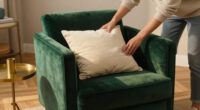
modern lounge chair with wooden frame
As an affiliate, we earn on qualifying purchases.
As an affiliate, we earn on qualifying purchases.
The Next Chapter for POÄNG
No new anniversary edition, product launch or event is announced in the source material. The immediate development is the chair’s 50-year milestone in 2026, alongside Livingetc’s review of the design and its evolution. IKEA has continued to offer variations and make technical or material updates, but the report does not set out a timetable for future changes.
Readers interested in buying one will need to check IKEA’s local catalogue for current models, finishes, prices and availability, which can differ by market. Any future claims about sales, revisions or health effects would need further information from IKEA or independent research.
As an affiliate, we earn on qualifying purchases.
Key Questions
When was the IKEA POÄNG chair designed?
The chair was introduced in 1976 as the POEM chair. It reaches its 50th anniversary in 2026.
Who designed the POEM chair?
The design was conceived by Japanese designer Noboru Nakamura with IKEA’s former design director, Lars Engman.
Why does the POÄNG chair move when someone sits in it?
Its cantilevered frame flexes under the sitter, creating a gentle swinging motion. Nakamura said the rocking-chair image inspired the design.
Does the chair have a proven anti-stress effect?
The source reports Nakamura’s view that swinging in the chair can help reduce stress and support wellbeing. It provides no clinical evidence establishing a medical or therapeutic effect.
How many POÄNG chairs has IKEA made?
Livingetc reports that IKEA has produced more than 30 million and sells an average of about 1.5 million a year. The source does not provide the underlying dataset or specify the period used for the annual average.
Source: rss
Fall Picks
fall essentials
As an affiliate, we earn on qualifying purchases.