
TL;DR

Get decor and gifts delivered free with Prime
- Fast, free delivery on millions of items
- Prime Video, Amazon Music and more included
- Member-only deals all year
Ideal Home has highlighted the “transition tree,” a decorating approach that updates one small tree across autumn, Halloween, Christmas and New Year’s. Interior experts say it can extend the use of seasonal decorations, but the report does not provide sales data or evidence that the idea is a breakout trend.
Ideal Home has spotlighted “transition trees,” small artificial or twig trees decorated first for autumn or Halloween and then updated for Christmas and New Year’s. The report presents the idea as a way to reuse seasonal decorations and maintain a focal point through the darker months, although it offers no sales figures or survey evidence to establish that the style is a breakout trend.
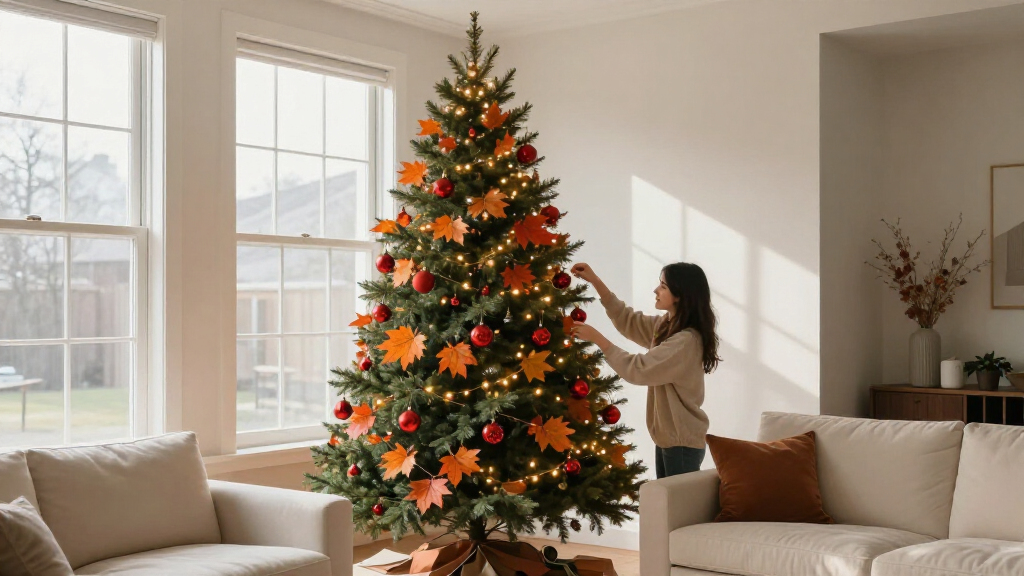
The concept is to put up one tree early and adjust its decorations over time, rather than remove one seasonal display and start again for the next. The report suggests either using a small artificial Christmas tree or choosing a more understated twig tree. Its recommendations range from autumn foliage and pine cones to Christmas baubles and, later, lights left on their own for a New Year’s look.
Victoria Robinson, a trend expert at Hillarys, told Ideal Home that a transition tree can create a focal point that remains relevant as the season changes. She said changing the same tree over time may offer more use from seasonal décor. Robinson also predicted that the approach could grow in popularity as homeowners consider decorations that can be styled in different ways. That is her assessment, not a measured forecast supported by data in the report.
Whinnie Williams, an interior designer and trends forecaster for Balsam Hill, suggested using existing decorations for Halloween, including toy spiders and webs, or making small ghost ornaments by covering baubles with white fabric. For a look that can carry into winter, the report recommends deep reds such as burgundy, paired with gold. Other suggested materials include dried foliage, faux berries, pine cones, velvet ribbons, amber-toned ornaments, subtle fairy lights and metallic accents.
One Tree, Several Seasonal Displays
For households that decorate for more than one autumn and winter occasion, the approach offers a practical alternative to putting up and taking down separate displays. Reusing one tree can make seasonal decorating more flexible and may help people get additional use from ornaments they already own. The report does not quantify any savings, so the cost effect will depend on what a household has and chooses to buy.
The idea also gives readers a way to avoid a sharp visual gap between Halloween and Christmas. A tree can begin with natural or autumn-coloured details, take on richer tones and lights as winter approaches, then shift to a pared-back display after Christmas. That progression is a decorating suggestion, not evidence that consumers broadly are adopting the trend.
For anyone considering the approach, the main practical point is that the tree does not need a full replacement of decorations at every stage. Changing a few ornaments or keeping the lights while removing baubles can create a different look with less work. The report’s guidance is aimed at styling; it does not include comparative costs, environmental measurements or advice on the durability of particular decorations.
As an affiliate, we earn on qualifying purchases.
From Halloween Trees to Winter
The report places transition trees within a wider seasonal decorating calendar in which some households begin decorating before Christmas, marking autumn and Halloween with wreaths and trees. It identifies Halloween trees as a decoration that has gained popularity this year, but gives no figures or source for that observation. It describes transition trees as a possible next step rather than a trend already established by market data.
Its examples show how the same display might change over several months: use foliage, pine cones, warm colours or Halloween ornaments in autumn; introduce burgundy, gold, lights and richer tones as winter nears; then remove the baubles and retain the lights for New Year’s. The central idea is gradual updating, not a requirement to follow a fixed schedule or buy a particular type of tree.
“Rather than decorating for Halloween and then starting again a few weeks later for Christmas, you can evolve the look of the same tree over time.”
— Victoria Robinson, trend expert at Hillarys, speaking to Ideal Home
twig decorative tree for seasonal decor
As an affiliate, we earn on qualifying purchases.
As an affiliate, we earn on qualifying purchases.
Trend Claims Without Market Data
It is not clear how widespread transition trees are, or whether more households are adopting them. Although the report’s headline calls them a breakout festive decorating trend, the article provides no sales data, consumer survey, search figures or comparison with previous years. Robinson’s comments about likely future popularity are expert opinion and should not be read as confirmed market evidence.
The report also does not set out a single definition of a transition tree. It may be a small artificial Christmas tree reused across seasons, a twig tree with minimal ornaments, or another display changed over time. The timing and extent of each redesign are left to individual households, and no evidence is provided about costs or how much reuse reduces waste.
As an affiliate, we earn on qualifying purchases.
How the Seasonal Look Can Change
The next steps described in the report are decorating suggestions rather than announced industry events. Households following the idea could start with autumn materials or Halloween ornaments, add winter colours and lights in November, then switch to Christmas decorations. After Christmas, Williams’s suggestion is to remove the baubles and leave the lights in place for a simpler New Year’s display.
Whether the idea gains wider traction remains to be seen. The source does not identify upcoming product launches, a retailer forecast or a date for further data. Any assessment of its popularity would require evidence such as sales, surveys or broader reporting beyond the decorating advice and expert comments in this article.
faux berry and pine cone decorations
As an affiliate, we earn on qualifying purchases.
As an affiliate, we earn on qualifying purchases.
Key Questions
What is a transition tree?
A transition tree is a small artificial or twig tree whose decorations are changed as the season moves from autumn and Halloween to Christmas and, potentially, New Year’s.
How can a tree work for both autumn and Christmas?
Start with foliage, pine cones, berries or warm-coloured ribbons, then add lights, metallic details or Christmas baubles as winter approaches. The report also suggests using burgundy and gold as colours that can suit both late autumn and Christmas.
Do transition trees save money?
They may let households reuse a tree and some decorations, but the report provides no cost comparisons. Any savings depend on the tree and ornaments a household already owns and whether it buys additional items.
Are transition trees confirmed to be a breakout trend?
No. Ideal Home’s report describes the idea as a potential emerging style, and one expert predicts it may become more popular. No sales figures or survey results are included to establish how widely households are using transition trees.
Source: rss
Halloween Picks
halloween
As an affiliate, we earn on qualifying purchases.